-
Admin
- Mon 24,Aug 2026
THE OFFICIAL LAUNCH OF THE AGRIPOLLINEX PROJECT AND FARMERS’ AND EXTENSION WORKERS’ NEEDS ASSESSMENT WORKSHOP HELD ON 11 AUGUST 2026
In line with its mandate to drive research, innovation and community engagement in agriculture and environmental sciences, the University of Agriculture and Environmental Sciences (UAES), Umuagwo, Imo State, in partnership with the Global Centre on Biodiversity for Climate (GCBC), successfully organised the Official Launch of the AGRIPOLLINEX Project and Farmers’ and Extension Workers’ Needs Assessment Workshop on 11 August 2026 at the ICT 3 Hall, UAES, Umuagwo. The event, funded by GCBC and supported by UK International Development, was held under the theme, “Enhancing Pollinator Biodiversity for Sustainable Agriculture and Climate Resilience.”
The event brought together key stakeholders from academia, government, research institutions and the farming community. In attendance were the Vice-Chancellor of UAES, Prof. Christopher C. Eze; the Principal Investigator of the AGRIPOLLINEX Project, Dr. Francis Ugochukwu Madu; representatives of the Global Centre on Biodiversity for Climate; directors and representatives of the Federal Ministry of Environment and the Federal Ministry of Agriculture and Food Security. Other participants included representatives of NIWAAFA, SHETSCO and the Federal University of Agriculture, Abeokuta (FUNAAB), as well as members of UAES Management, academic and non-academic staff, farmers, extension agents, media representatives and development partners.
The programme commenced with the registration of participants, followed by the procession of principal officers and special guests. This was followed by the National Anthem, the University Anthem and an opening prayer.
In his welcome address, the Vice-Chancellor, Prof. Christopher C. Eze, described the launch as a historic milestone for UAES and commended Dr. Francis Ugochukwu Madu and the project team for securing competitive international funding. He emphasised that the AGRIPOLLINEX Project directly addresses critical issues relating to pollinator decline, food security and climate change.
Goodwill messages were subsequently delivered by the Principal Investigator, the GCBC representative who joined virtually, and representatives of the Department of Climate Change in the Federal Ministry of Environment and the Federal Ministry of Agriculture and Food Security.
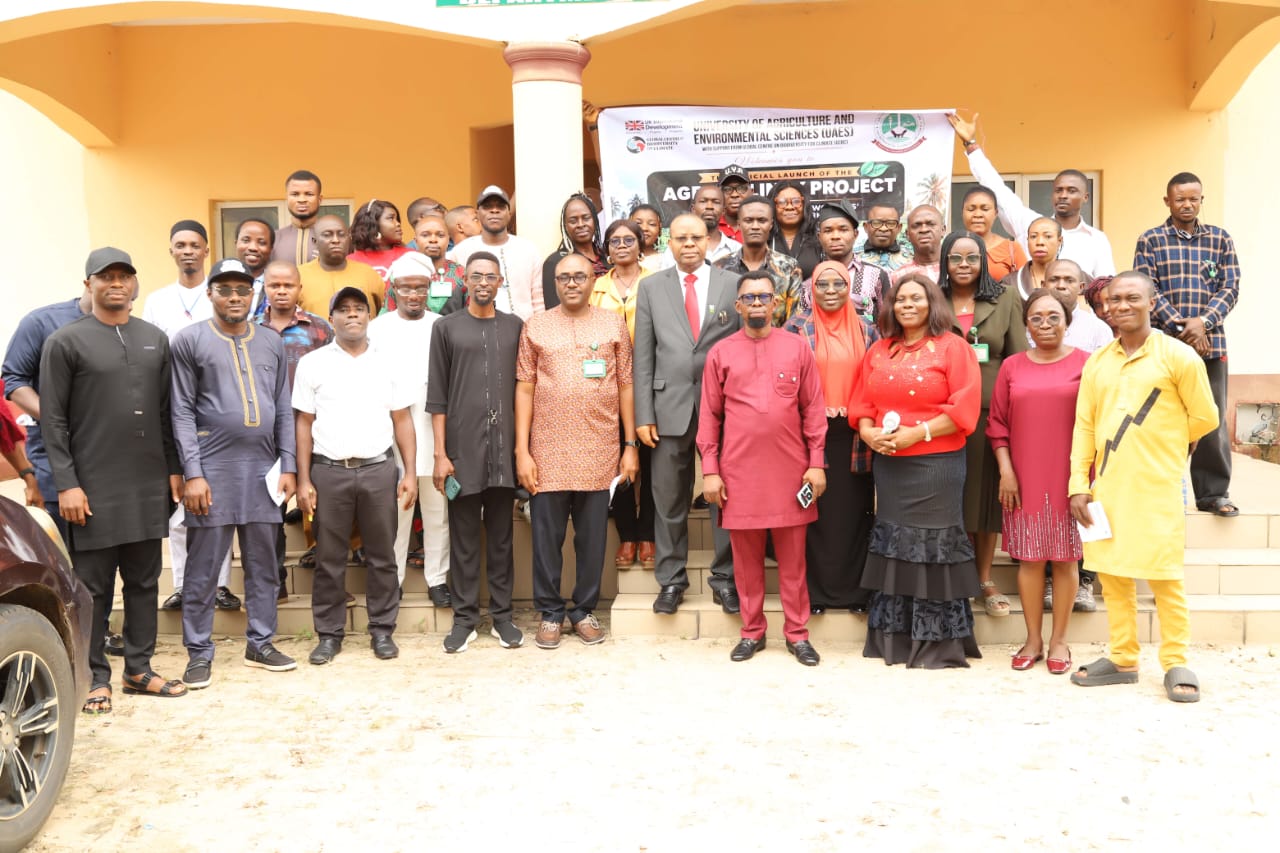
The Principal Investigator, Dr. Francis Ugochukwu Madu, thereafter delivered a detailed presentation on the vision, objectives, expected outcomes and strategic partnerships of the AGRIPOLLINEX Project. The project was formally unveiled by the Vice-Chancellor alongside the special guests, after which a group photograph was taken to commemorate the occasion.
Following the launch, Session II of the programme, the Farmers’ and Extension Workers’ Needs Assessment Workshop, commenced. The session was chaired by a representative of NIWAAFA, with the Project MEL Coordinator serving as Rapporteur.
The workshop began with an introduction by NIWAAFA, followed by a technical presentation titled “Pollinators, Biodiversity and Climate-Resilient Agriculture,” delivered by SHETSCO. An interactive session facilitated by NIWAAFA provided an opportunity for farmers to share their current farming practices and the challenges they encounter. NIWAAFA subsequently led the process of identifying and prioritising the most pressing needs of farmers and extension workers.
This was followed by an interactive question-and-answer session, during which participants engaged with the issues raised and shared their experiences and perspectives. The programme ended with closing remarks by the Vice-Chancellor, Prof. Christopher C. Eze, and an expression of appreciation to all participants for their contributions.
The AGRIPOLLINEX Project is expected to achieve several strategic outcomes, including the generation of robust scientific data on pollinator diversity and its impact on crop productivity in Nigeria; the promotion and scaling of climate-smart and pollinator-friendly agricultural practices among smallholder farmers; the provision of evidence to support policy formulation through engagement with the Federal Ministries of Environment and Agriculture and Food Security; enhanced food security and improved rural livelihoods through the integration of biodiversity conservation into agricultural systems; and the positioning of UAES as a hub for international collaborative research on biodiversity and climate.
The needs assessment component of the project will ensure that project interventions are evidence-based and tailored to the actual needs of farmers and extension workers.
In conclusion, the successful launch of the AGRIPOLLINEX Project and the conduct of the needs assessment workshop reaffirm UAES’s commitment to impactful research that addresses agricultural development, environmental sustainability and community well-being. It is recommended that the findings from the needs assessment be fully integrated into the project implementation strategy, while collaboration with GCBC, the Federal Ministries and other partners should be sustained. It is also important that project results and best practices be widely disseminated to relevant stakeholders.
The University extends its profound appreciation to the Global Centre on Biodiversity for Climate for its grant support and to all participants for their valuable contributions to the success of the event.
