-
Admin
- Thu 06,Nov 2025
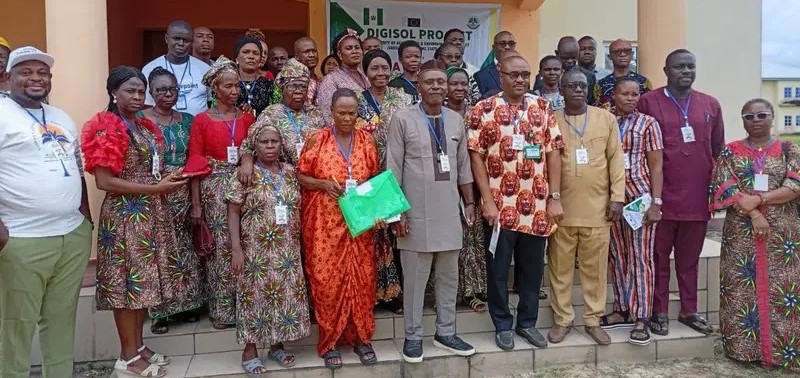
University (UAES) train rural Farmers on climate finance
The University of Agriculture and Environmental Sciences (UAES), Umuagwo, Imo State, in collaboration with the Federal University of Agriculture, Abeokuta, Ogun State, and Al-Hikmah University, Ilorin, Kwara State, have embarked on training rural Farmers on climate finance as well as processes to access such funds.
The one-day event took place at the Infotech Building, UAES, in Imo state, last Thursday and supported by the European Union (EU) under the auspices of the DIGISOL Project.
It was focused on sustainable finance for investments in small-scale agro enterprises in rural communities.
Speaking at the event, the Acting Vice Chancellor of UAES, Prof. Christopher Eze, emphasized that the agricultural sector remains a vital component of Nigeria’s economy.
Eze who was represented by the Deputy Vice Chancellor, Dr. Obinna Adumanya, noted that “small-scale agro enterprises form the backbone of the sector” however, he said the sector has continued to face challenges in accessing financial instruments, resulting to limitation in the growth and contribution of the sector to national development.
On what the workshop intended to achieve, Adumanya said it would “enlighten participants—mostly farmers—on the workings and processes of climate finance, including the criteria for accessing such funds as well as to create awareness of innovative funding schemes designed to reduce poverty and promote sustainable development.
“Through the EU-funded DIGISOL Project, we have assembled a diverse group of microfinance experts, local authorities, and stakeholders to share insights, experiences, and best practices in sustainable finance for small-scale agro enterprises, particularly in rural communities.
“It is on record that the DIGISOL Project, now in its third year of pilot implementation across selected local government areas in Imo, Ogun, and Kwara States, has made tremendous positive digital and financial impacts on the lives and activities of farmers in rural communities,” he added.
In her presentation titled: “Exploring Climate Finance Options under Agricultural Finance: Sustainable Development Goals by 2030,” a gender expert, Dr. Chinwe Nwogu, lamented that many women in rural areas were finding it difficult to access agricultural funding. She encouraged women farmers to take advantage of mobile financial services to obtain insurance coverage when accessing agricultural loans.
She noted that climate finance could play a crucial role in making agriculture part of the climate solution while empowering rural women through capacity building. “Women are more likely to benefit from climate finance because they constitute the majority of residents in rural farming communities,” she added.
Also speaking, a financial expert, Mr. Chinedu Anowuru, advised farmers that any project seeking climate finance support should demonstrate measurable community impact. Pointing out that “only projects capable of improving the lives of rural dwellers will be honored by the Green Climate Fund (GCF), which Nigeria is already accredited to access.”
In his remarks, the National Coordinator of the DIGISOL Project, Dr. Chinasaokwu Onyemuwa, explained that the workshop was designed to equip farmers with the knowledge and tools needed to access funding and increase productivity for the overall benefit of the society.
Source: Vanguard
